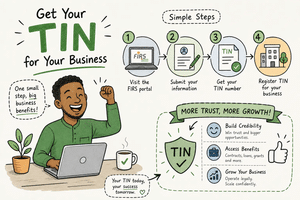
A Tax Identification Number (TIN) is a unique code issued to individuals and businesses in Nigeria for tax purposes. You can apply for one through the Federal Inland Revenue Service (FIRS), the Joint Tax Board (JTB), or, for registered companies, automatically through the Corporate Affairs Commission (CAC) during incorporation. Having a valid TIN is essential for opening a business bank account, filing taxes, and complying with Nigerian tax law.
Taxes rarely make for exciting conversation, but if you’re running a business or working in Nigeria, understanding your Tax Identification Number is unavoidable. Without one, you can’t open a corporate bank account, bid for government contracts, or stay on the right side of the Federal Inland Revenue Service.
This guide breaks down what a TIN is, who needs one, and exactly how to get yours without wasting hours in a tax office queue.
What is a TIN Number in Nigeria?
A Tax Identification Number, commonly shortened to TIN, is a unique identifier assigned to every taxpayer in Nigeria — whether that’s an individual, a sole proprietorship, a registered company, or a non-governmental organisation. The Federal Inland Revenue Service (FIRS) and the Joint Tax Board (JTB) jointly administer the TIN system, ensuring that every taxpayer across the country’s 36 states and the Federal Capital Territory can be tracked within a single, unified database.
Think of your TIN as your tax fingerprint. It links your income, tax payments, and filings to one identity, no matter which state or federal agency you’re dealing with.
Who Needs a TIN in Nigeria?
Nigerian tax law requires the following categories of people and entities to obtain a TIN:
- Registered companies and businesses: Any entity incorporated with the Corporate Affairs Commission (CAC) is automatically issued a TIN as part of the registration process.
- Self-employed individuals and sole proprietors: Freelancers, consultants, and small business owners who aren’t operating under a CAC-registered entity still need to register for a TIN with their relevant state tax authority or the FIRS.
- Salaried employees: Workers in both the public and private sectors typically have a TIN registered on their behalf through their employer’s PAYE (Pay As You Earn) scheme.
- Non-residents earning income in Nigeria: Foreign individuals or companies with Nigerian-sourced income are also required to obtain a TIN.
If you fall into any of these categories and don’t yet have a TIN, it’s worth sorting out sooner rather than later — many banks, government agencies, and business partners will ask for it before doing business with you.
How Can You Apply for a TIN as an Individual?
Individuals in Nigeria can register for a TIN through the Joint Tax Board’s online portal or by visiting their state Internal Revenue Service office. The process generally involves:
- Gathering your documents: You’ll typically need a valid means of identification (National ID, international passport, or driver’s licence), your Bank Verification Number (BVN), and proof of address.
- Completing the application form: This can be done online via the JTB TIN registration portal or in person at a tax office.
- Submitting your details for verification: The tax authority cross-checks your information, often against your BVN record, to prevent duplicate registrations.
- Receiving your TIN: Once verified, your TIN is issued, usually via email or SMS, and can also be retrieved later through the JTB portal.
Choose the online route if you want speed and convenience. Choose the in-person route if you’re not confident navigating digital forms or if your documentation needs manual verification.
How Do Businesses Get a TIN Number in Nigeria?
For registered companies, the process is more straightforward because TIN issuance is now tied directly to business registration.
What happens during CAC registration?
When you register a company with the Corporate Affairs Commission, your business is automatically assigned a TIN as part of the incorporation process. This integration between the CAC and FIRS systems means most newly registered companies no longer need to apply separately.
What if your business already exists but doesn’t have a TIN?
If your company was registered before this integration took effect, or if your TIN wasn’t issued automatically for any reason, you can apply directly through the FIRS TaxPro-Max platform or visit your nearest FIRS office with your Certificate of Incorporation, Memorandum and Articles of Association, and valid identification for your business’s directors.
You may also like to read: How to brief a Lagos web design company for a high-converting website and funnel
Why Does Having a TIN Matter?
A TIN isn’t just a bureaucratic formality — it unlocks practical functions that Nigerian individuals and businesses rely on regularly:
- Opening a corporate bank account: Nigerian banks require a TIN before they’ll open an account in a company’s name.
- Filing annual tax returns: You can’t file your personal or company income tax returns with FIRS without a valid TIN.
- Bidding for government contracts: Public sector tenders typically require proof of tax registration.
- Applying for business loans: Financial institutions often request a TIN as part of their due diligence process.
- Import and export operations: Businesses involved in international trade need a TIN to clear goods through Nigerian customs.
Choose to prioritise your TIN application early if you’re planning to scale a business, seek funding, or work with government institutions — these all depend on your tax compliance status.
What Happens If You Don’t Have a TIN?
Operating without a TIN when you’re required to have one can create real friction. Banks may refuse to open or maintain your business account, government agencies may reject your applications, and you could face penalties for non-compliance with Nigerian tax law. For businesses especially, the absence of a TIN can stall operations at critical moments, such as mid-negotiation with a bank or supplier who requires tax documentation before proceeding.
Take the Next Step Toward Tax Compliance
Getting your TIN sorted is one of those administrative tasks that feels tedious until the moment you desperately need it — mid-loan application, mid-tender submission, or mid-negotiation with a new bank. Whether you’re an individual taxpayer or a growing business, registering early saves you from scrambling later.
If you haven’t yet secured your TIN, start with the Joint Tax Board portal for individual registration or confirm your status through FIRS TaxPro-Max if you run a business. A few minutes of paperwork now can save you significant delays down the line.
Frequently Asked Questions
How much does it cost to get a TIN in Nigeria?
Registering for a TIN is free of charge, whether you apply as an individual through the JTB portal or as a business through FIRS or CAC.
How long does it take to receive a TIN?
Processing times vary, but individuals applying online often receive their TIN within a few working days, while business TINs issued through CAC registration are typically generated immediately as part of incorporation.
Can I check my existing TIN if I’ve forgotten it?
Yes. You can retrieve your TIN through the JTB TIN verification portal using your BVN or registered phone number, or by contacting your state’s Internal Revenue Service.
Is a TIN the same as a BVN?
No. A Bank Verification Number (BVN) identifies you for banking purposes, while a TIN identifies you specifically for tax purposes. However, your BVN is often used to verify your identity during TIN registration.
Do foreigners working in Nigeria need a TIN?
Yes. Non-resident individuals and companies earning income within Nigeria are required to register for a TIN to remain compliant with Nigerian tax obligations.