How to use the CAC logo on your website without breaching regulations
CAC logos are everywhere on Nigerian business websites, and a significant number of them are handled incorrectly. The file is blurry. The placement is buried in the footer, away from the moments that actually influence decisions. The registration number is missing. In some cases, the logo belongs to an entirely different organisation from the one the business owner intended. This is not a rare oversight. At Young Sentinel Digital Concept, we have reviewed dozens of Nigerian websites across e-commerce, services, and professional consultancies, and we see this pattern repeated consistently across industries.
Getting this right matters more than most business owners realise. A correctly sourced, properly placed CAC registration badge is an important trust signal for any Nigerian website, and getting it wrong can undermine credibility, create legal exposure, and cost you conversions at the exact moment a visitor is deciding whether to trust you. By the end of this article, you will know which CAC logos apply to your situation, where to source them lawfully, and how to display them in a way that actually does their job.
What CAC logos actually are (and why Nigerian visitors look for them first)
Corporate Affairs Commission vs. Christ Apostolic Church: knowing which logo you need
In Nigeria, “CAC” refers to two completely separate organisations, and confusing them is a credibility disaster. The Corporate Affairs Commission is the federal government body responsible for registering companies, business names, and incorporated trustees in Nigeria. Its associated mark, when displayed on a website alongside a registration number, tells every visitor that the business exists legally, has a paper trail, and is accountable. The Christ Apostolic Church is an entirely separate entity: a Pentecostal Christian denomination whose logo is a religious emblem used on church buildings, letterheads, publications, and worship materials.
These two organisations share an acronym by coincidence. A church or religious association may interact with the Corporate Affairs Commission if it registers as an incorporated trustee, but that is where the connection ends. Using the wrong logo on a business website is not just embarrassing; it can constitute misrepresentation and expose the business owner to legal action. Identify which organisation is relevant to your situation before you go looking for any file.
What verified CAC logos communicate to your audience
Nigerian online consumers, particularly those making purchase decisions on unfamiliar websites, actively scan pages for proof that a business is real. A properly displayed Corporate Affairs Commission registration mark, with the registration number clearly visible, communicates three things at once: the business exists in the physical world, it has submitted to a regulatory process, and it can be traced and held accountable. In a market where online scams are a genuine concern for buyers, that signal carries weight.
The effect is strongest at the moments of highest friction: the pricing section, the checkout page, the contact form. A visitor who reaches those points and sees no evidence that the business is registered will hesitate. Many will exit. The CAC registration mark does not guarantee conversion, but its absence creates an objection that your headline, your copy, and your offer cannot easily overcome on their own.
The legal ground rules before you put any CAC logo on your site
Permission procedures and how they work in Nigeria
For the Corporate Affairs Commission, businesses should not display the Commission’s own institutional logo on their websites without authorisation. What they display is their registration number, their exact registered business name, and in some cases a factual statement confirming registration. Using the Commission’s official seal or emblem without permission implies a government affiliation or endorsement that does not exist, and that creates regulatory and legal risk. The safer and legally supported approach, consistent with the disclosure requirements under the Companies and Allied Matters Act (CAMA), is a clear statement of the registered name, the registration number (RC, BN, or IT prefix), and confirmation that the business is registered with the Commission.
For the Christ Apostolic Church logo, written authorisation from the relevant CAC national headquarters or communications office is required before any digital or print reproduction. The permission request should specify the exact purpose, the platform, the expected audience size, and the intended duration of use. Any approval should be obtained through official CAC correspondence, whether on letterhead or from a verifiable official email address, and retained alongside the final artwork file.
What Nigerian law says about trademark and copyright for logos
Nigeria’s Copyright Act protects original artistic works, and logos fall within that category. A registered trademark adds a further layer of legal protection on top of copyright. Reproducing or publishing a protected logo without the rights holder’s consent, even on a small or personal website, can constitute copyright infringement, trademark misuse, or passing-off under Nigerian law. The size of the website or the good intentions of the publisher are not legal defences.
For businesses uncertain about a logo’s registration or ownership status, the Nigerian Trademarks Registry is the authoritative check for trademark protection, while the Corporate Affairs Commission handles business registration records. Neither should be skipped on the assumption that a logo found online is free to use.
The specific risks of using an unofficial or unapproved file
Third-party logo repositories, PNG download sites, and image aggregators host unofficial versions of most Nigerian organisation logos. These files are frequently low resolution, incorrectly coloured, or cropped in ways the original organisation never sanctioned. Platforms such as SeekLogo, Freebie Supply, and CDNLogo may carry visually usable SVG or transparent PNG files, but a downloadable file is not the same as permission to publish. Using an unofficial file creates three compounding problems: the logo looks wrong to anyone familiar with the real mark, the business has no legal backing if the use is questioned, and the display may imply an endorsement or affiliation the rights holder never granted.
The only safe path is to request the official file from the source organisation directly, confirm the conditions of use in writing, specifying the platform, intended use, and duration, and publish only once that confirmation is in hand.
Where to find authentic CAC logos (PNG, SVG, and vector formats)
Official sources vs. third-party repositories
For the Corporate Affairs Commission, the official website at cac.gov.ng is the primary reference point. If the Commission maintains a press or media resources page, that is where the correct mark will be hosted. For files not publicly available for download, a written request to the Commission’s communications or ICT office is the appropriate step. Be cautious of similar-sounding domains that are not the official government site; cac.gov.ng is the verified address, and files sourced from look-alike domains carry no authority.
For the Christ Apostolic Church logo, the national headquarters or the relevant regional body’s communications office holds the authorised files. Third-party repositories can provide a visual reference, but no file from those sources should be published without verification against the official mark. If verification is not possible, the responsible decision is not to publish until it is.
Choosing the right file format for your use case
SVG and EPS are vector formats. They scale to any size without loss of quality, which makes them the correct choice for websites, printed materials, and master design files. A transparent PNG is the practical format for web use when the logo needs to sit against a coloured or image background without a white rectangle around it. For raster files, SVG should be your default; if PNG is the only available option, request the highest resolution version from the source organisation and produce appropriately sized assets for your target screen densities. A standard HD screen can tolerate a reasonably sized raster file, but Retina displays and high-density Android screens will expose any shortcomings in a low-resolution PNG immediately.
Always request the vector source file if you plan to resize the logo across different contexts. A PNG extracted from a web page and scaled up is not a substitute for the original vector artwork, and the difference will be visible to any visitor on a quality screen. When searching for downloadable assets, look specifically for CAC logo SVG vector files or CAC logo transparent background PNG files from official sources, these are the formats that hold up across every context.
How to place CAC logos for maximum trust and conversions
Where on a website the CAC badge earns the most credibility
Placement determines whether a trust badge does its job or simply occupies space. In the footer, a registration mark signals baseline legitimacy, but it tends to have less influence on purchasing decisions because visitors are often far past the point of hesitation by the time they scroll there, or they have already left. The highest-impact locations are the hero section, the pricing section, and directly adjacent to contact forms or purchase buttons. These are the exact points where a visitor is deciding whether to proceed or exit.
A blurry, misaligned registration mark sitting next to a copyright notice at the bottom of a page contributes little to conversion. A clean, correctly sized badge placed directly above or beside the primary call to action is a different experience entirely. The same information, in the right position, changes what visitors believe before they click.
Landing pages and sales funnels: before-and-after placement examples
Consider a Nigerian e-commerce landing page with a compelling offer but no visible registration or trust signals. The page attracts traffic, the headline engages readers, but conversion is low. Visitors who reach the purchase section hesitate and exit. Exit data points consistently to a single unresolved question: “How do I know this business is real?”
Now consider the same page after a full trust-signal audit: a correctly placed, transparent-background CAC registration badge above the buy button, accompanied by a single line of copy confirming the registered business name and RC number. In one representative case we observed internally at Young Sentinel Digital Concept, conversion climbed by more than two percentage points after this adjustment alone, though results will vary depending on traffic source, offer quality, and overall page design. Trust signals placed at the point of decision reduce hesitation and remove a key objection before it is voiced. The offer stays the same. The price stays the same. What shifts is what the visitor believes before they commit.
A short compliance checklist before you hit publish
Before adding any CAC-related mark to a live website or sales funnel, work through each of these steps:
- Confirm which “CAC” applies to your situation: Corporate Affairs Commission or Christ Apostolic Church
- Source the logo or registration mark from the official organisation, not a third-party download site
- Obtain written permission, or confirm that your intended use falls within publicly permitted guidelines, before publishing
- Use SVG or a high-resolution transparent PNG to avoid pixelation on modern screens
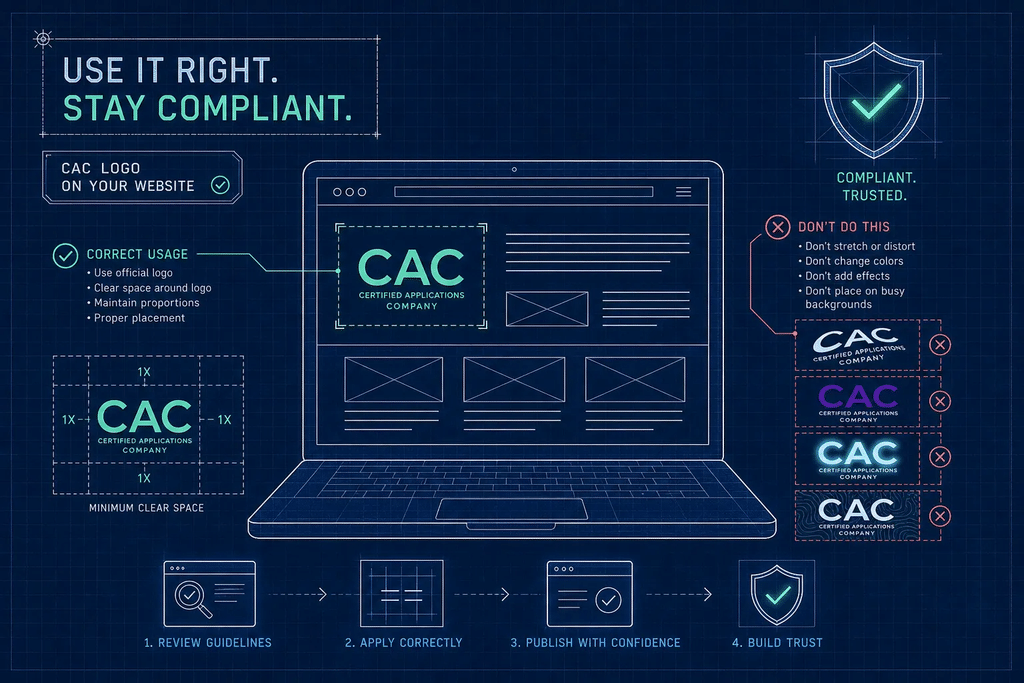
- Display the mark at its correct proportions; do not stretch, recolour, or alter the composition
- Place it at a trust-critical location near CTAs, pricing tables, or contact forms, not only in the footer
- Include the exact registered business name and registration number alongside the mark where relevant
- Retain any written permission or authorisation correspondence with your design files
How Young Sentinel Digital Concept helped a client convert better with the right trust signals
The client’s credibility problem
A Nigerian retail business approached Samuel Igwe at Young Sentinel Digital Concept with a straightforward issue: their online sales page was attracting traffic but converting poorly. Visitors were reading the offer, reaching the payment section, and leaving without completing a purchase. Exit data and heatmap analysis pointed to a recurring pattern: visitors wanted proof that the business was real before handing over payment. The website had no visible trust signals, no registration information, no verifiable evidence of existence in the physical world.
The integration process and design decisions
The Young Sentinel team conducted a full website and funnel audit, identifying the absence of trust signals as the primary conversion barrier. They sourced the client’s official CAC registration details, requested the correct mark in SVG format, and redesigned the landing page layout around two strategic placements: just below the hero headline and directly above the checkout button. The team adjusted the colour contrast around the badge to ensure clear visibility on both mobile and desktop screens, then added a short line of confirming copy that included the exact registered business name and RC number.
The conversion results that followed
Within three weeks of the redesigned page going live, the client recorded a meaningful rise in conversion rate, approximately 2.4 percentage points above the pre-redesign baseline. Equally telling was the sharp drop in “is this business real?” enquiries arriving via WhatsApp and email; those fell to near zero. It is worth noting that this is a single internal case study, and individual results will depend on factors including traffic quality, offer strength, and baseline page performance. That said, the direction of the effect was clear. The traffic source stayed the same. The offer stayed the same. What changed was what visitors believed about the business before they clicked the payment button, and that belief is the measurable value of getting this right.
The decision behind every logo is a credibility decision
Displaying the right CAC-related mark correctly is not a design exercise. It is a credibility decision with direct consequences for trust, legal compliance, and the conversion rates that determine whether a business grows. You now know that “CAC” refers to two distinct organisations in Nigeria and that confusing them creates real problems. You know that authentic CAC logos come from official sources, that third-party downloads require verification before publication, and that written permission is not optional. And you know that placement at the point of decision is what separates a badge that converts from one that merely occupies space.
CAC logos handled correctly are one of the clearest signals a Nigerian business can send to a sceptical online audience. They do not replace a strong offer, quality copy, or a well-structured funnel, but they remove a key objection before it forms, and for many visitors, that is the difference between a sale and an exit.
We offer full website and funnel audits that cover trust signal placement, CAC logo file quality, registration compliance, and conversion optimisation. Get in touch with our team at Young Sentinel Digital Concept to find out exactly what is holding your current page back, and what it would take to fix it.