How to perform conversion rate optimisation on small business websites in Nigeria
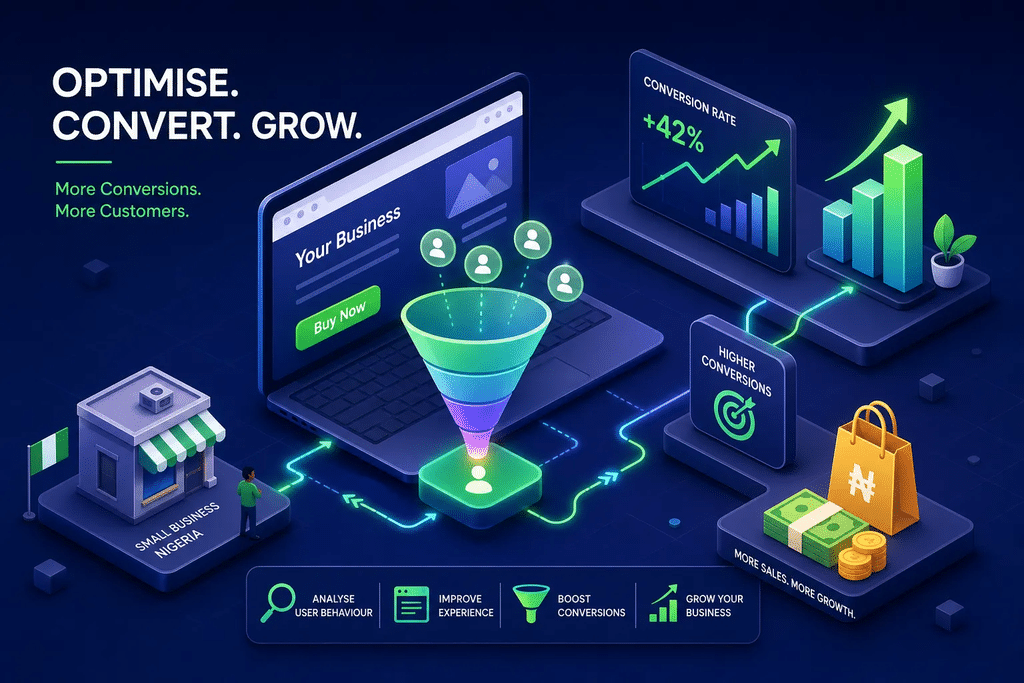
Most Nigerian small business websites convert between 1% and 3%. That means 97 out of every 100 visitors leave without doing anything, and if you are pouring money into Google Ads or Instagram promotions, you are sending more people into a leaky funnel. More traffic does not fix a broken funnel. Fix the funnel first, then drive traffic, that is what conversion rate optimisation (CRO) is designed to do.
At Young Sentinel Digital Concept (founded by Samuel Igwe), we have audited dozens of Nigerian business websites, and the same blockers appear repeatedly: slow mobile load times, forms with too many fields, vague calls to action, and zero trust signals near the decision point. This article is a distillation of that field work. By the end, you will know how to measure where you stand, find what is stopping people from converting, run experiments without a big budget, and understand what the numbers look like when the fixes actually work.
What your conversion rate is really telling you
The formula is simple: divide the number of completed conversions by total sessions, then multiply by 100. If your website received 2,000 sessions last month and 40 people submitted your contact form, your conversion rate is 2%. What counts as a conversion depends on your business, and that definition matters enormously. For a Nigerian business, a conversion might be a completed purchase, a WhatsApp button click, a phone call, a lead form submission, or a booked consultation. Pick one clearly defined goal per page and track it consistently in Google Analytics 4, confirming the events are firing correctly before drawing any conclusions from the data.
Use the conversion rate benchmarks in the table below to understand whether your current rate is a crisis or simply room for incremental improvement:
| Industry / website type | Typical benchmark | Strong performance target |
| E-commerce / retail | 1%–3% | 3%–5%+ |
| Professional services | 2%–5% | 5%–8%+ |
| Legal services | 4%–8% | 8%–12%+ |
| Education / training | 4%–8% | 8%–12%+ |
| Real estate | 1.5%–4% | 4%–7%+ |
| Financial services / fintech | 2%–5% | 5%–8%+ |
| Healthcare | 2%–4% | 4%–7%+ |
| B2B SaaS / software demos | 1%–3% | 3%–5%+ |
Benchmark your rate first; optimise second. A professional services site converting at 4% is performing solidly, above the typical midpoint for that category, though there is still headroom before reaching the 5%–8% strong-performance range. The same 4% rate on an e-commerce store means you are near the top of your category. Context changes everything, which is why conversion rate benchmarks matter before any experiment begins.
How to audit your website for conversion rate optimisation blockers
Before changing anything, you need to know precisely where visitors are dropping off and why. Two highly recommended free tools handle this well. Google Analytics 4 shows you the exact funnel step where the largest drop-off occurs. Microsoft Clarity shows you session recordings and heatmaps so you can watch real visitors at that step. Together, these two tools replace expensive agency diagnostics for any Nigerian SME doing early-stage CRO work.
Set up GA4 for conversion rate optimisation
Set up GA4 first and confirm that your key events are firing correctly: form submissions, WhatsApp button clicks, phone calls, and checkout completions. In the funnel exploration report, look for steps where the drop-off is notably higher than the rest, those are your priority areas. The 60% threshold is not a hard rule; your goal is simply to identify which step loses the most visitors and start there.
Use Microsoft Clarity for qualitative CRO insights.
Install Microsoft Clarity, wait a week to collect meaningful recordings, and filter sessions for the page with the highest drop-off. Watch ten to fifteen of those recordings as a practical starting point, you will begin to see behavioural patterns that raw numbers alone cannot surface. In Clarity, watch for rage clicks on non-clickable elements, excessive scroll without engagement, and sessions that end at the form.
In our experience at Young Sentinel Digital Concept, four blockers appear more consistently than any others across the sites we review:
- Slow page load on mobile, particularly on 3G and 4G connections common across Nigeria
- Forms that ask for too many fields before delivering any value to the user
- CTAs that are vague, buried below the fold, or duplicated without purpose
- Missing trust signals near the decision point, such as no address, no reviews, and no payment logos
Conversion rate optimisation starts with identifying which of these four blockers is costing you the most visitors. Your tools will tell you; the recordings and funnel data simply confirm what your visitors have already been showing you.
Conversion rate optimisation quick wins: mobile, forms, and trust signals
The majority of Nigerian web traffic comes from mobile devices, largely mid-range Android phones on variable connections. Speed is the single biggest lever you can pull. Research from Google shows that moving from a one-second load time to three seconds raises the probability of bounce by approximately 32%; at five seconds versus one second, that figure climbs to around 90%. A site that loads in under three seconds on a 4G connection will outperform a beautiful site that loads slowly every time.
The highest-impact mobile fixes are not complicated. Compress images to keep file sizes as small as possible, for many images, under 150KB is a reasonable target, though this depends on the image role and required quality. Remove pop-ups that cover the CTA on small screens. Ensure buttons are at least 48px tall and spaced for thumb use, in line with established touch-target guidelines. Make your WhatsApp contact button visible without scrolling. These are not design preferences; they are high-priority, evidence-backed practices for any Nigerian business that relies on mobile traffic to drive enquiries.
On forms, the principle is straightforward: every additional field is a reason to abandon. In our own client work, reducing forms from eight fields to four consistently improved completion rates. Ask yourself whether each field is needed to deliver the service or just to qualify the lead prematurely, and remove the latter category entirely. For Nigerian audiences, the trust signals placed near the conversion point matter as much as the form itself. A local phone number, a physical address or state of operation, recognisable payment logos such as Paystack or Flutterwave, and at least one authentic client testimonial close to the submit button all reduce the anxiety that causes visitors to hesitate before completing the final step.
Microcopy and CTAs: small words, big results
A strong CTA removes uncertainty about what happens after the click. Compare “Submit” against “Get my free audit”, or “Click here” against “Send a WhatsApp message now.” The difference is not cosmetic. The first version forces the visitor to guess what comes next; the second tells them exactly what they are getting and at what commitment level. Use the formula: verb plus specific outcome plus a time or effort indicator. “Book a 20-minute call” is better than “Book a call.” “Get your free quote in 24 hours” is better than “Request a quote.”
Microcopy is the small instructional text that surrounds your forms, buttons, and error messages. Adjusting it for Nigerian context reduces drop-off in ways that are easy to implement but often overlooked. Explain that “we will call you within one business day.” Confirm that “your details are not shared with third parties. ” Specify which payment methods are accepted. These small additions directly address the trust gap that causes Nigerian buyers to abandon the purchase at the very last moment. First-person CTA wording, “Get my free quote” rather than “Get your free quote”, has also shown meaningful lifts in copy testing, making it worth evaluating once your other fundamentals are in place.
Low-cost A/B testing for Nigerian small businesses
Most Nigerian small business sites do not have enough traffic to run formal A/B tests immediately, and that is fine. Sites below 1,000 monthly sessions should prioritise usability fixes and qualitative research over split tests, because the data will not reach statistical confidence within a reasonable time frame. The rule of thumb: you need at least 10,000 monthly visitors to the tested page before a conventional A/B test produces reliable results. Below that threshold, fix the obvious issues first and measure the before-and-after impact.
When you are ready to test, the right tool stack depends on your budget. Start with Microsoft Clarity and GA4 for qualitative research and landing page optimisation insights at no cost. When you need experimentation features, Zoho PageSense offers a free tier for sites under 5,000 monthly visitors, with paid plans starting around $20 per month. Zoho offers naira billing through local payment processing, which avoids the foreign-exchange costs and card restrictions that come with dollar-denominated tools. Crazy Egg is an alternative if you prefer a simpler interface, though its entry paid plan starts around $29 per month billed in USD, making PageSense the more budget-friendly choice for most Nigerian businesses.
When you write a test hypothesis, use this format: “For [audience] with [observed problem], if we [specific change], then [metric] will improve because [behavioural reason].” A concrete Nigerian example: “For mobile visitors arriving from Instagram ads, if we replace the six-field contact form with a two-field form and a WhatsApp button, form submissions will increase because typing on mobile is a barrier.”
Run one test at a time. Measure completed conversions, not clicks. That discipline is what separates conversion funnel optimisation from guesswork.
A real CRO audit: from 1.4% to 4.1% in 45 days
A Lagos-based professional services business came to Young Sentinel Digital Concept with steady traffic but a conversion rate under 1.5%. The site looked professionally designed but had a seven-field enquiry form, no trust signals near the CTA, a homepage that loaded in six seconds on mobile, and a generic “Submit” button. Microsoft Clarity recordings showed visitors scrolling past the form without engaging. The form was not broken; it was simply asking for too much, too soon, with nothing nearby to justify the trust required to complete it.
After the audit, three targeted changes were implemented: the form was reduced to three fields, a single client testimonial with a specific outcome was placed directly above the CTA, and the mobile load time was cut from six seconds to under three seconds through image compression and removal of two unnecessary third-party scripts. No changes were made to the ad budget or traffic sources.
Within 45 days, the enquiry conversion rate moved from 1.4% to 4.1%, an uncontrolled before-and-after comparison rather than a formal split test, but one tracked consistently in GA4 with no significant changes to traffic sources or seasonality during the period. The same visitors simply converted at a higher rate. This is what conversion rate optimisation actually delivers: more revenue from the visitors you already have, before you spend a single additional naira on advertising.
Start with your audit, then fix what matters first
Conversion rate optimisation is not a one-time fix or an advanced technical discipline reserved for large companies. It is a repeatable process: measure, observe, form a hypothesis, test a change, read the result. Nigerian small businesses that follow this process consistently will compound small gains into meaningful revenue growth over time, without increasing their marketing spend.
The sequence is straightforward: establish your baseline in GA4, audit with Microsoft Clarity recordings, fix the highest-impact blockers first (mobile speed, form length, trust signals, and CTA copy), run disciplined tests once your traffic volume permits, and track completed conversions rather than intermediate clicks. That sequence works on a landing page, a service page, or a full e-commerce checkout flow.
If you want a structured starting point, our team at Young Sentinel Digital Concept offers a free website and funnel audit for Nigerian small businesses ready to understand exactly why their site is not converting and what to fix first. The audit covers load speed, mobile usability, form friction, CTA clarity, and trust signals, and it delivers a prioritised action list rather than a generic report. Book your audit and leave with clear next steps, not another document you will not read.